


04 Jun Couples Counseling Benefits for Long-Term Relationships
Modern relationships require more than goodwill to thrive—they benefit from structured, evidence-based relational frameworks. Unlike generalized self-help, professional couples counseling integrates clinical assessment and targeted interventions to help partners address challenges systematically. In recent U.S. studies, structured marriage counseling has been associated with substantially higher relationship satisfaction compared with no counseling. This guide explains how clinical—and, when desired, faith-integrated—approaches can produce measurable improvements in relationship health.
This article outlines how couples therapy differs from individual work, five evidence-informed outcomes you can expect, a common three-phase clinical roadmap, signals for when to seek help, and some common myths debunked. Use these sections to decide whether professional support is the right next step for your relationship.

Couples Therapy vs. Individual Counseling: What’s the Clinical Difference?
Individual therapy centers on a person’s inner world. By contrast, relationship counseling focuses on the couple as a system, using dyadic assessment tools and interventions tailored to interaction patterns. Licensed U.S. therapists (LMFT, LPC, psychologists) commonly draw on:
- Gottman Method assessments and interventions to evaluate and strengthen relationship stability .
- Attachment-informed approaches that help partners understand how early bonding patterns shape communication, trust, and money decisions.
- Communication skills training and cognitive-behavioral strategies to prevent escalation and resolve conflict; evidence and applicability vary by couple and context.
By treating the relationship as its own clinical unit, therapists can identify recurring interaction cycles and interrupt patterns that individual-focused therapy might not address directly. This systemic lens is particularly helpful when problems are maintained by feedback loops between partners rather than by one person’s symptoms alone.
5 Evidence-Informed Outcomes of Professional Couples Therapy
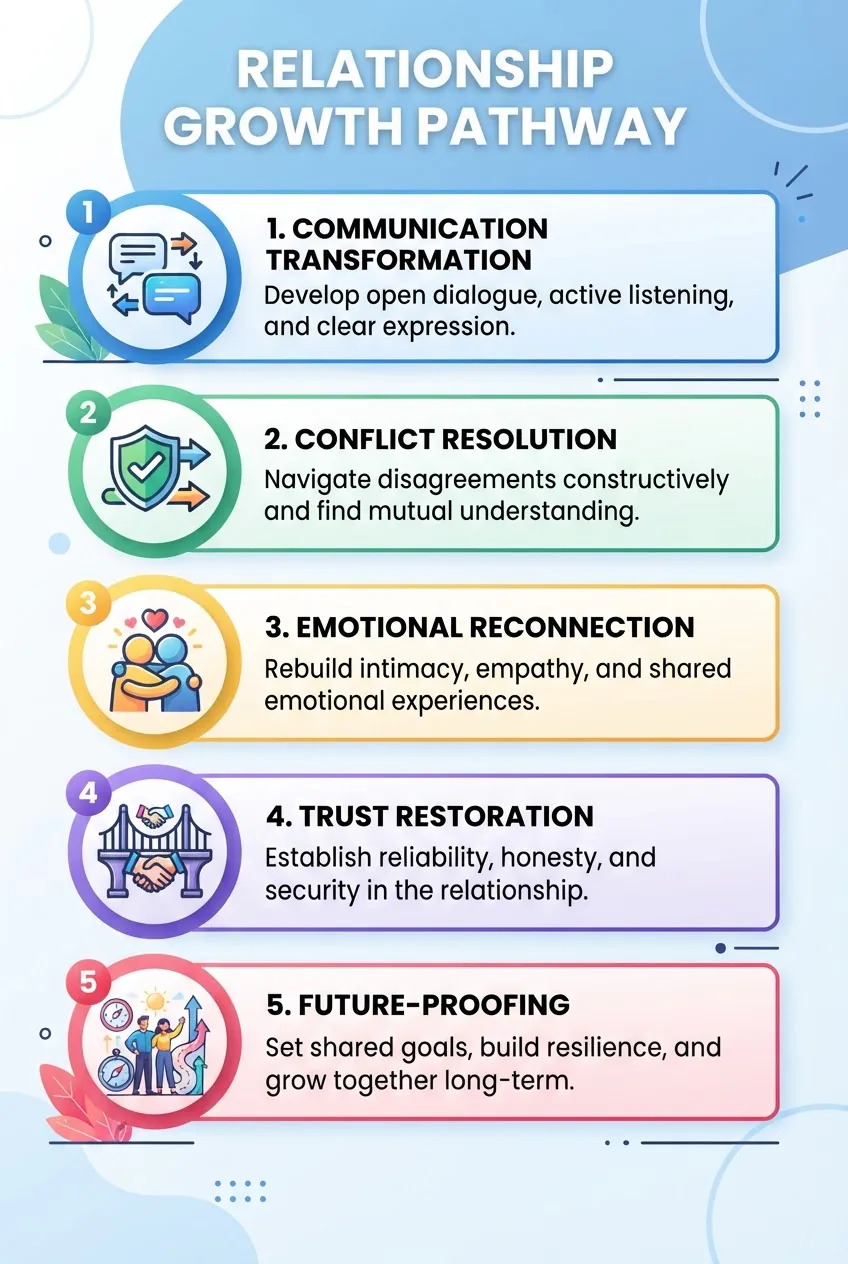
Across multiple programs and studies, couples who participate in structured therapy often report meaningful gains. While exact percentages vary by method and sample, commonly observed outcomes include:
- Communication transformation: Improved use of de-escalation skills and clearer expression of needs, including techniques drawn from nonviolent communication principles.
- Conflict resolution: Reduced hostile interactions and greater problem-solving efficacy using tools such as the Sound Relationship House (learn more from the Gottman framework).
- Emotional reconnection: Better emotional attunement and co-regulation during difficult conversations, helping partners feel safer and more supported.
- Trust restoration: Attachment repair work that increases security, reliability, and follow-through on agreements.
- Future-proofing: Strategies that address the impact of stress and Adverse Childhood Experiences (ACEs) on adult relationships (overview from the CDC).
Outcomes are influenced by factors such as the model used, therapist skill, engagement level, and the presence of complicating issues (e.g., untreated substance use or severe mental illness). Tracking small, concrete indicators—like frequency of repair attempts or weekly check-ins—helps couples and clinicians measure progress and adjust the plan.
It’s helpful to recognize the common issues in couples counseling to better address underlying challenges.
The 3-Phase Clinical Roadmap: What Happens in Sessions?
Many licensed couples therapists use a phased, research-aligned structure. A typical roadmap looks like this:
Timelines below are approximate; some couples need a shorter or longer course depending on history, complexity, and goals. Therapists often tailor pacing and content to meet each couple where they are.
Phase 1: Biopsychosocial Assessment (Weeks 1–2)
- Use of validated inventories such as PREPARE/ENRICH to identify strengths and growth areas.
- Genogram work to map multigenerational patterns that affect communication, intimacy, and beliefs (see resources through AAMFT).
- DSM-5-TR–informed screening when relevant, to understand how individual mental health considerations may interact with relationship dynamics.
Phase 2: Skill Acquisition (Weeks 3–6)
- Imago Dialogue or similar structured conversations for trauma-informed communication and empathy-building.
- Emotionally Focused Therapy (EFT) techniques that strengthen secure attachment and de-escalate negative cycles (research summary via ICEEFT).
- Behavioral and communication skills practice focused on repair attempts, fair-fighting rules, and collaborative problem-solving.
Phase 3: Relational Future-Proofing (Weeks 7–8)
- Stress-inoculation training (SIT)–style exercises to rehearse coping strategies before high-stress events arise (definition via the APA Dictionary of Psychology).
- Maintenance planning: scheduling check-ins, setting boundaries around time and technology, and creating early-warning systems for recurring issues.
When Should Couples Consider Professional Intervention?
According to clinical guidance and professional consensus (see the American Psychological Association’s couples resources), consider therapy when you notice:
- Communication breakdowns lasting longer than a month.
- Recurring arguments about the same issues with little resolution.
- Significant drops in physical or emotional intimacy.
- High-stakes transitions (e.g., career shifts, relocation, parenthood, caregiving).
Earlier intervention—before patterns become entrenched—often results in faster, more durable improvements, but it’s never too late to seek help. If safety is a concern (threats, violence, stalking), prioritize immediate safety planning and resources.
Debunking 3 Common Therapy Myths
Myth 1: “Counseling means our relationship is failing.”
Reality: Many high-functioning couples use therapy proactively to strengthen connection and prevent problems. Seeking support is a sign of commitment, not failure.
Myth 2: “All therapists use the same methods.”
Reality: Approaches vary widely. Look for clinicians trained in evidence-based couples models (e.g., Gottman Method, EFT, Integrative Behavioral Couple Therapy) and appropriate credentials (LMFT, LPC, psychologist), along with relevant certifications or AAMFT-approved training.
Myth 3: “We can fix things ourselves.”
Reality: Self-help tools can be valuable, but guided therapy typically improves skill uptake and application because it offers feedback, structure, and accountability—all tailored to your unique interaction patterns.
Understanding these realities can reduce resistance to seeking help and make the therapy process more effective when you do begin.
Conclusion: The Case for Professional Guidance
Investing in couples therapy gives partners a structured, science-informed path to stronger communication, deeper trust, and more resilient connection. If you’re ready to take the next step, consider finding the best couples counseling services in your area. To learn more or find a provider, visit Psychology Today or explore the American Psychological Association’s couples therapy resources.
Whether your goal is to repair a breach, navigate a life transition, or deepen an already strong partnership, professional couples counseling can accelerate learning and create sustainable change. Consider a brief consultation to assess fit, ask about the clinician’s couples-specific training, and discuss whether faith-integrated options are available if that aligns with your values.
References
- Gottman, J. (2011). The Science of Trust. University of Washington Press.
- International Centre for Excellence in Emotionally Focused Therapy (ICEEFT). EFT Research Overview. Retrieved from https://iceeft.com/eft-research/
- National Institute of Mental Health. (2023). Therapy and Counseling. Retrieved from https://www.nimh.nih.gov/health/topics/therapy-for-couples
- Centers for Disease Control and Prevention (CDC). Adverse Childhood Experiences (ACEs). Retrieved from https://www.cdc.gov/violenceprevention/aces/index.html
- American Psychological Association. Evidence-based practice in psychotherapy. Retrieved from https://www.apa.org/topics/psychotherapy/evidence-based
Sorry, the comment form is closed at this time.