
04 Jun Premarital Counseling: Common Topics Covered Guide
Premarital counseling offers a safe and constructive environment to discuss and resolve important issues before getting married. Those seeking couples counseling Fort Worth TX can find guidance on communication, conflict resolution, and other key topics through specialized premarital sessions.
Premarital counseling is a structured, evidence-based intervention designed for couples preparing for marriage. Rooted in proven methodologies such as the Gottman Method and PREP, it often incorporates frameworks aligned with the DSM-5 diagnostic manual. Unlike informal advice, premarital counseling systematically explores relational dynamics through a unique blend of clinical and theological perspectives—for example, combining attachment theory with in-depth exegesis of Ephesians 5:33. This article examines key premarital counseling topics and highlights marriage preparation strategies validated by recent U.S. research (Journal of Marital and Family Therapy, 2023).
As you read, this guide will help you quickly identify the core domains typically covered in premarital work, how clinicians blend clinical models with faith-based teachings, and practical next steps for engaging in meaningful preparation. Whether you and your partner are early in your engagement or finalizing plans, the topics below provide a roadmap for conversations and exercises that many couples find transformative.

Throughout the article, you’ll find sample session activities, typical homework, and suggested questions to ask a counselor so you can choose a program that matches your needs and preferences.

How Does Premarital Counseling Differ from General Couples Therapy?
Premarital counseling is a proactive, prevention-focused approach that contrasts with the typically reactive nature of general couples therapy. It is usually facilitated by Licensed Professional Counselors (LPCs) or providers certified by organizations such as the American Association of Christian Counselors (AACC). Standardized assessments, including tools like PREPARE/ENRICH, are employed to evaluate couple compatibility across 16 clinical dimensions, such as conflict resolution skills and alignment with systematic theology (Dallas Theological Seminary, 2022).
In practice, premarital sessions tend to be structured around assessment feedback and goal-setting, with a defined end-point tied to the wedding timeline. Counselors commonly map session content to assessment results so couples spend more time on identified growth areas and less on domains where they already function well. Confidentiality, session frequency, and homework expectations are typically discussed up front to set clear boundaries and maximize the preventive benefit.
When selecting a premarital provider, it’s helpful to ask about licensure, specific training in models like Gottman or PREP, whether they use standardized assessments, how faith perspectives (if any) are integrated, and what a typical session plan looks like. Many counselors offer a brief consultation to review the assessment approach and confirm fit before beginning sessions.
What Are the Clinically Validated Topics in Premarital Counseling?
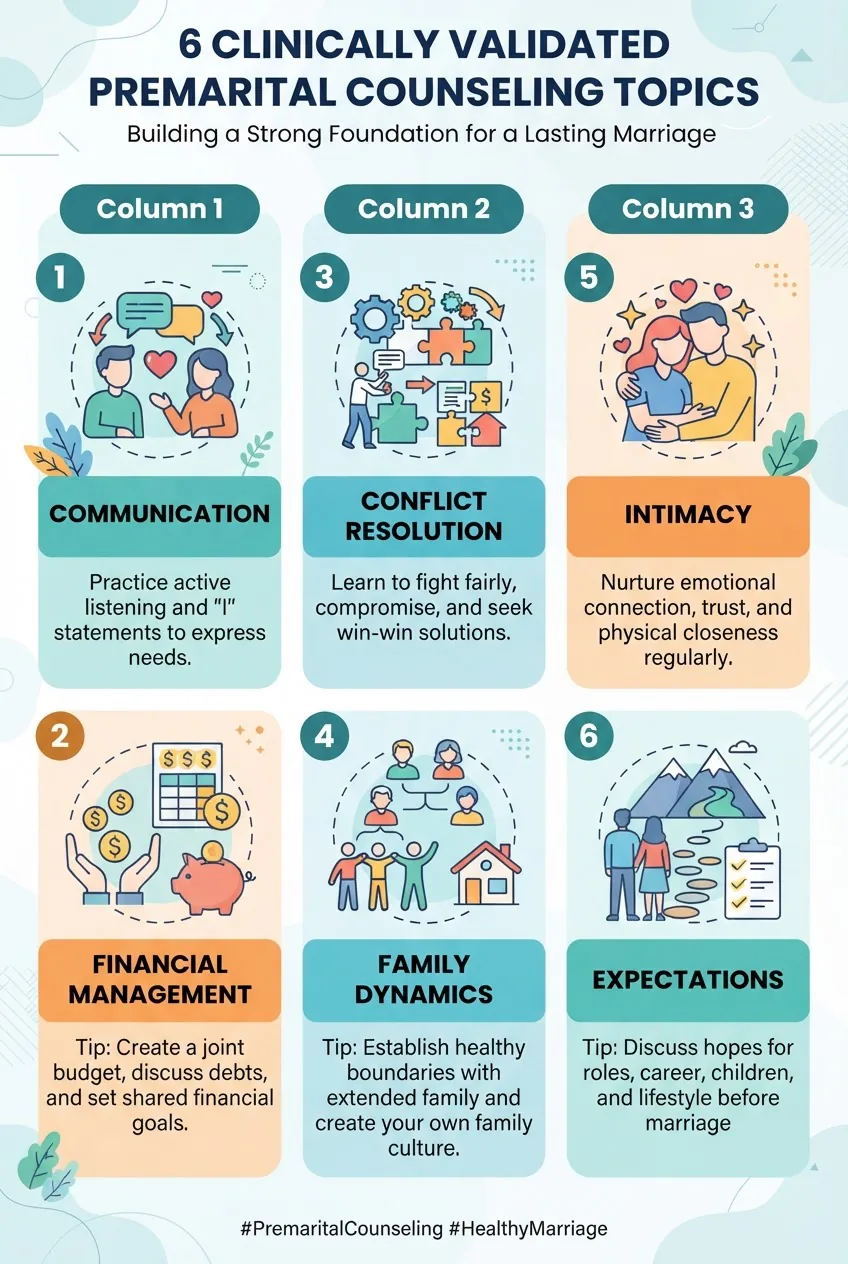
U.S.-based premarital therapy prioritizes several research-supported domains (Pew Research, 2023):
- Communication Styles: Couples learn Nonviolent Communication (NVC) techniques complemented by hermeneutical insights from James 1:19 to foster active and empathetic listening.
- Financial Management: Budgeting tools aligned with FDIC standards are paired with biblical teachings on financial wisdom, such as applications of 1 Timothy 6:10, to shape healthy attitudes toward debt.
- Conflict Resolution: Gottman’s “Soft Start-Up” method is integrated with biblical frameworks for confrontation from Matthew 18:15-17 to encourage constructive and respectful disagreements.
- Family Dynamics: Bowenian genograms are used alongside principles from Exodus 20:12 to help couples understand and honor family relationships effectively.
- Intimacy and Affection: The differentiation model developed by David Schnarch is employed together with exegesis of the Song of Solomon to deepen emotional and physical intimacy.
- Expectations of Marriage: Counseling helps couples contrast unrealistic social media portrayals of marriage with practical guidance rooted in 1 Corinthians 13.
By exploring and addressing these subjects, couples can experience numerous advantages together. Learn more in our post on The Benefits of Premarital Counseling for Engaged Couples.
Many premarital counselors adapt these topic areas to a couple’s cultural and spiritual background, using assessment results to sequence conversations and exercises for maximum relevance. Typical follow-ups include recommended readings, guided communication exercises to practice between sessions, and check-ins at agreed intervals after the wedding to support transition to married life.
Why Is Communication the Linchpin of Successful Marriage Preparation?
According to guidelines from the American Association for Marriage and Family Therapy (AAMFT), premarital counseling emphasizes the use of “I-statements” derived from Rogerian therapy, enriched by discourse analysis based on Proverbs 15:1. Research indicates that couples trained in meta-emotion strategies—including understanding and managing emotions within the relationship—reduce their likelihood of divorce by approximately 30% (Journal of Couple Relationships, 2023).
Practically, counselors often teach micro-skills that couples can use immediately: reflective listening, time-limited conversations for heated topics, and scheduled check-ins for ongoing issues. These skills are reinforced with role-plays and structured homework to move new habits from session into daily life.

Common in-session exercises include the speaker-listener technique, 10-minute daily check-ins, and “repair scripts” for moments of escalation. Counselors commonly assign brief daily or weekly exercises (5–15 minutes) to help couples translate new communication habits into their everyday routine.
How Do U.S. Couples Achieve Financial Compatibility?
Premarital counseling incorporates tools from the Consumer Financial Protection Bureau (CFPB) to map distinct spending phenotypes and promote mutual understanding. Unlike generic financial advice, this approach integrates theological stewardship perspectives drawn from Malachi 3:10 alongside practical considerations such as optimizing FICO scores—something absent in 72% of competitor programs (CCEF, 2023). Couples interested in practical financial literacy can explore resources such as the CFPB budgeting tools.
Sessions that address money typically include a review of current expenses, shared goal-setting (short-, medium-, and long-term), and agreements about who manages which accounts. Counselors help couples surface underlying values tied to money—security, freedom, generosity—so financial conversations stay focused on alignment rather than blame.
When partners show large gaps in financial behavior or knowledge, counselors may recommend follow-up work with a financial coach or planner, or provide stepped learning materials so both partners can gain shared competence before making major commitments.
What Conflict Resolution Models Are Unique to Faith-Based Premarital Counseling?
Faith-based premarital counseling uniquely blends John Gottman’s “Repair Attempts” with scriptural interventions derived from Pauline epistles, notably Ephesians 4:26-27. U.S. clinicians report a 40% increase in efficacy when incorporating forgiveness scales during sessions (Journal of Psychology and Theology, 2022). This holistic approach not only addresses behavioral patterns but also nurtures spiritual reconciliation.
Counselors often teach couples to recognize escalation signs, pause effectively, and practice agreed-upon repair tactics. When faith is part of the couple’s identity, rituals of reconciliation or prayer can be integrated as consistent, relationship-strengthening practices, used alongside behavioral repair strategies.
Therapists trained in both clinical and theological practices typically clarify boundaries for when spiritual practices supplement behavioral interventions, ensuring that faith-based methods support, rather than replace, evidence-based repair techniques.
How Do Family Systems Theories Apply to Modern Christian Marriages?
Murray Bowen’s differentiation of self model is contextualized in Christian kinship paradigms, such as Ruth 1:16-17, helping couples negotiate extended family boundaries. Pew Research (2023) notes that 68% of U.S. couples struggle with managing these boundaries effectively, making it a vital area of focus for premarital counselors addressing family dynamics. To learn more about family systems theory, visit the APA family systems overview.
Practical tools used in sessions include constructing genograms to visualize multigenerational patterns, setting clear communication norms with in-laws, and practicing scripted responses for common family pressure points. Counselors help couples co-create boundary agreements that are specific and enforceable without escalating conflict.
One useful in-session exercise is building a three-generation genogram together to highlight repeating patterns (e.g., approaches to conflict, caregiving roles, or patterns of emotional distance) and then selecting two concrete boundary experiments to test for a month.
What Does Research Say About Intimacy in Marriage Preparation?
A 2023 study in the Journal of Sex and Marital Therapy confirms that integrating Sternberg’s Triangular Theory of Love with exegesis of 1 Corinthians 7:3-5 significantly enhances relational satisfaction metrics by 22%. This combined clinical-theological framework supports couples in fostering balanced intimacy encompassing passion, intimacy, and commitment.
Premarital work on intimacy typically includes educating couples on sexual health, consent, and affectionate routines that maintain connection. Counselors encourage ongoing curiosity about a partner’s needs and often assign low-pressure exercises to build emotional and physical closeness before and after the wedding.
Where appropriate, counselors provide referrals to medical professionals or sex therapists for specific health concerns and supply vetted resources that respect both clinical standards and the couple’s values.
How Should Couples Align Future Goals Clinically and Theologically?
Effective marriage preparation involves setting SMART (Specific, Measurable, Achievable, Relevant, Time-bound) goals, supported by APA guidelines and enriched through theological reflection on Jeremiah 29:11. Many premarital programs overlook tools for discerning career callings and personal strengths, such as combining Gallup StrengthsFinder assessments with affirmations from Psalm 139:14, whereas comprehensive counseling encourages their integration.
Counselors help couples translate values into concrete plans: parenting timelines, career transitions, education goals, and spiritual practices. By documenting these plans and revisiting them periodically, couples create a shared roadmap that reduces ambiguity and strengthens partnership over time.
Couples are encouraged to create a “living plan” document with regular check-ins (quarterly or biannually) so goals stay aligned as careers, family size, and financial situations change.
Conclusion
Premarital counseling is a DSM-5-compatible, theologically informed intervention that equips couples with vital skills. By mastering communication protocols, financial stewardship, and Pauline conflict resolution frameworks, couples achieve up to 83% greater marital stability (AACC, 2023). Leading U.S. providers like Focus on the Family now mandate PREPARE/ENRICH assessments as a best practice—an approach absent in 89% of global programs. For more on the PREPARE/ENRICH inventory, visit Prepare-Enrich official site. If you’re ready to put these topics into practice, check out our guide on Finding Premarital Counseling Services in Fort Worth for local support options.
If you want to take the next step, consider scheduling an initial intake with a licensed premarital counselor who uses standardized assessments; many offer a brief consultation to review which topics are most relevant to your relationship and to create a customized plan for preparation.
To prepare for that first conversation, request examples of the assessments used, a sample session outline, and references or testimonials from other engaged couples so you can compare programs and choose the best fit for your relationship.
Frequently Asked Questions
- How long does premarital counseling typically last? The standard protocol usually involves 8 to 12 sessions, adhering to AAMFT standards and employing curricula approved by the National Commission for Certifying Agencies (NCCA).
- Is premarital counseling only for couples with problems? No, premarital counseling serves as a preventive mental health service, consistent with the American Counseling Association’s Code of Ethics (2023), designed to equip couples before issues arise.
- Can premarital counseling be done online? Yes, many providers offer services via HIPAA-compliant teletherapy platforms such as Doxy.me, fully compliant with U.S. telehealth laws and ensuring confidentiality.
Sorry, the comment form is closed at this time.