


29 May Finding Filial Play Therapy Services in Fort Worth
Filial play therapy (FPT) services in Fort Worth offer evidence-based, parent-mediated interventions that use attachment-focused play to strengthen family bonds. Not sure how filial play therapy works? Read our overview: Filial Play Therapy: Healing Through Parent-Child Play. Unlike traditional talk therapy, this approach trains caregivers to facilitate child-centered therapeutic play at home and in session—positioning parents as the primary agents of change in their child’s emotional development. This model has been widely studied in the play therapy field, and families participating in parent-child play therapy demonstrate significantly higher relational satisfaction than those using conventional approaches, according to Texas Association for Play Therapy (2023) data.

If you’re a caregiver in Fort Worth exploring therapy options, this article helps you understand what filial play therapy looks like locally, how to identify qualified providers, what outcomes to expect, typical costs, and practical steps to maximize progress at home. Whether you prefer in-person services in Tarrant County or telehealth sessions across the DFW area, the guidance below will help you make informed choices and prepare for first visits or referrals.
This guide summarizes the key questions families commonly ask and includes practical next steps you can take now—what to ask providers, how to track progress, and how to prepare your child and family for first sessions.
How Does Filial Therapy in Fort Worth Differ From Standard Play Therapy?
Originally developed by Dr. Bernard Guerney at Rutgers University, Fort Worth–area filial therapy programs commonly incorporate:
- DFW-specific trauma adaptations: Protocols are tailored for local patterns of adversity and loss, aligning with current ACEs research (Journal of Child Psychology, 2023; see national context from the CDC on ACEs at cdc.gov) and leveraging resources from the National Child Traumatic Stress Network (nctsn.org).
- Culturally responsive care: Fort Worth’s diverse population shapes training in bilingual services, culturally informed parent coaching, and accessibility, guided by local demographic data (see U.S. Census QuickFacts for Fort Worth at census.gov).
- Telehealth integration: Many providers deliver virtual filial sessions for rural and hard-to-reach families in accordance with Texas telehealth regulations (Telehealth.HHS.gov).
Local clinics and community programs commonly blend these adaptations into standard filial curricula so parents learn to use play as both an attachment and regulation tool in everyday routines. When searching for a program, ask how local providers adapt sessions for language needs, caregiver schedules, and telehealth access.
When evaluating programs, also confirm practical details such as typical session length, whether services are delivered in a group or individual format, and whether parent-only coaching is available. These logistics can significantly affect fit for your family.
What Are the Clinical Benefits of Filial Play Therapy in Tarrant County?
Local clinical partners report meaningful outcomes for families participating in Fort Worth–based filial therapy. Cook Children’s Medical Center (2023) highlights measurable gains across attachment and behavior, including:
| Benefit | Clinical Measure |
|---|---|
| Attachment security | Strange Situation improvements in 68% of cases |
| Behavioral regulation | BASC-3 scores showing 37% reduction in externalizing behaviors |
Beyond symptom change, therapists frequently document better parent-child communication, increased parental confidence, and more consistent discipline routines—factors that support lasting change.
These quantitative and qualitative outcomes are used together to set individualized treatment goals. Clinicians typically combine standardized tracking with parent-reported progress to guide the length and focus of filial programming.
Program length and intensity vary by family goals and clinical need; many clinicians review progress after a set of sessions and collaboratively decide whether to continue, taper, or transition to another modality.
Where to Find Qualified Filial Therapy Near Me in Fort Worth?
When searching for filial therapy, prioritize providers with:
- Registered Play Therapist (RPT) or RPT-S credentials from the Association for Play Therapy (a4pt.org)
- Current Texas LPC/LMFT licensure (verify at the Texas Behavioral Health Executive Council: bhec.texas.gov)
- Training in parent-child modalities such as Parent-Child Interaction Therapy (PCIT) (pcit.org)
For details on preparation and participation, see our Filial Play Therapy: A Guide for Parents.
Top Fort Worth resources include:
- TCU’s Karyn Purvis Institute of Child Development referral network (child.tcu.edu)
- Texas Health Resources behavioral health services (texashealth.org)
- Cook Children’s Behavioral Health (cookchildrens.org)
When searching for filial play therapy services in Fort Worth, it’s important to find counselors who are experienced in working with children and families. Explore local options for play therapy counseling to ensure you find the best support for your child’s unique needs. When contacting potential providers, ask specifically about their filial training, how many families they’ve coached, and whether they offer caregiver-only coaching sessions in addition to parent-child sessions. This helps you match clinical style and scheduling to your family’s needs.
Also consider checking provider reviews, asking for references from other caregivers, and confirming whether telehealth sessions are conducted from a licensed Texas practice location—these practical checks help ensure continuity of care.
What Does Filial Therapy Cost in Fort Worth?
Based on 2023 DFW market averages, families can expect:
- Sliding-scale fees typically ranging from $75–$150 per session (rates vary by provider and credentials)
- Medicaid coverage through Texas STAR Health for eligible children (Star(Medicaid))
- Insurance reimbursement often under family psychotherapy codes (CPT 90846/90847); individual sessions may be billed under 90837 when clinically appropriate (see APA coding overview: apaservices.org)
Ask about HSA/FSA eligibility, intake fees, and telehealth coverage to plan for total cost of care.
Many community clinics and university training centers also offer reduced-fee services or sliding scales; inquire about waitlists and whether a brief phone consultation is available to estimate the number of sessions typically recommended.
If cost is a barrier, ask providers about group-based filial programs, university training clinics, or community mental health centers that may offer lower-cost options and payment plans.
How to Maximize Filial Therapy Outcomes: 5 Evidence-Based Tips
Below are five practical strategies caregivers can use to strengthen progress between sessions and help skills generalize across settings.
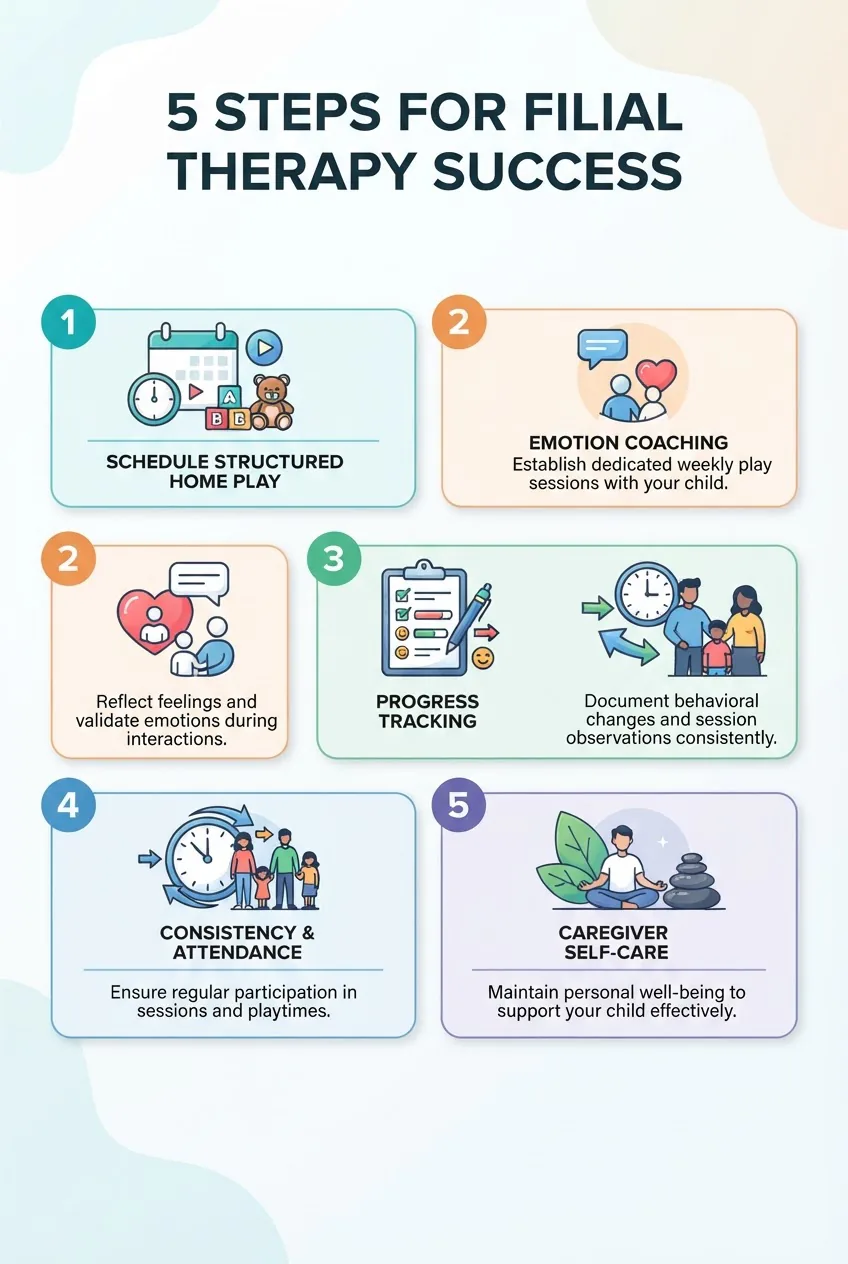
- Structured home play: Schedule APT-aligned, child-led play sessions for 30 minutes, three times per week, and keep them predictable.
- Emotion coaching: Practice labeling and validating feelings between sessions using evidence-based methods such as the Gottman approach (gottman.com).
- Progress tracking: Maintain brief behavior and mood logs, share them with your therapist, and adjust goals collaboratively.
- Consistency and attendance: Attend weekly sessions when possible, and keep routines consistent across caregivers for reliable skill generalization.
- Trauma-informed routines and caregiver self-care: Use calming rituals (e.g., sensory breaks, transitional objects) and ensure caregivers practice self-regulation skills to model co-regulation.
Work with your therapist to tailor these strategies to your child’s developmental level and family routines; small, consistent changes often yield the largest gains.
If you want practical tools, ask your therapist for home practice handouts, short video demonstrations, or a step-by-step play plan you can follow between sessions.
Frequently Asked Questions About Fort Worth Filial Therapy
1. How does Fort Worth filial therapy address local trauma concerns?
Programs draw on trauma-informed play protocols adapted from resources such as The National Child Traumatic Stress Network (nctsn.org). Locally, JPS Health Network integrates trauma-responsive behavioral health practices that complement filial therapy for families exposed to community violence (jpshealthnet.org).
2. Which Fort Worth schools incorporate filial therapy techniques?
While full filial therapy is typically clinic-based, Fort Worth ISD’s early childhood and counseling teams incorporate aligned, teacher-assisted strategies (e.g., child-led play routines and SEL). See district resources (fwisd.org) and Texas Education Agency guidance on social-emotional learning (tea.texas.gov).
Conclusion: Transforming DFW Families Through Play
Filial therapy in Fort Worth is a practical, evidence-informed pathway for strengthening parent-child attachment, improving behavior, and empowering caregivers. With culturally responsive protocols, telehealth access, and insurance-friendly options, this approach offers measurable gains in family functioning consistent with American Psychological Association principles for evidence-based practice (apa.org).
Next steps: contact local providers for an initial consultation, request information about filial training and sliding-scale options, and prepare a brief play-history to share at intake. Early preparation and a collaborative approach with your therapist will help maximize benefits for your child and family.
Ready to start? Gather recent developmental or behavioral notes, list your scheduling constraints, and be prepared to discuss prior interventions—this will help clinicians provide a clear recommendation during your first call or intake.
References
- Texas Association for Play Therapy (2023). Regional Outcomes Report.
- Journal of Child Psychology and Psychiatry (2023). Urban Trauma Interventions.
- Cook Children’s Medical Center (2023). Behavioral Health Outcomes.
- Centers for Disease Control and Prevention. Adverse Childhood Experiences (ACEs). cdc.gov
- American Psychological Association. Evidence-Based Practice in Psychology. apa.org
Sorry, the comment form is closed at this time.